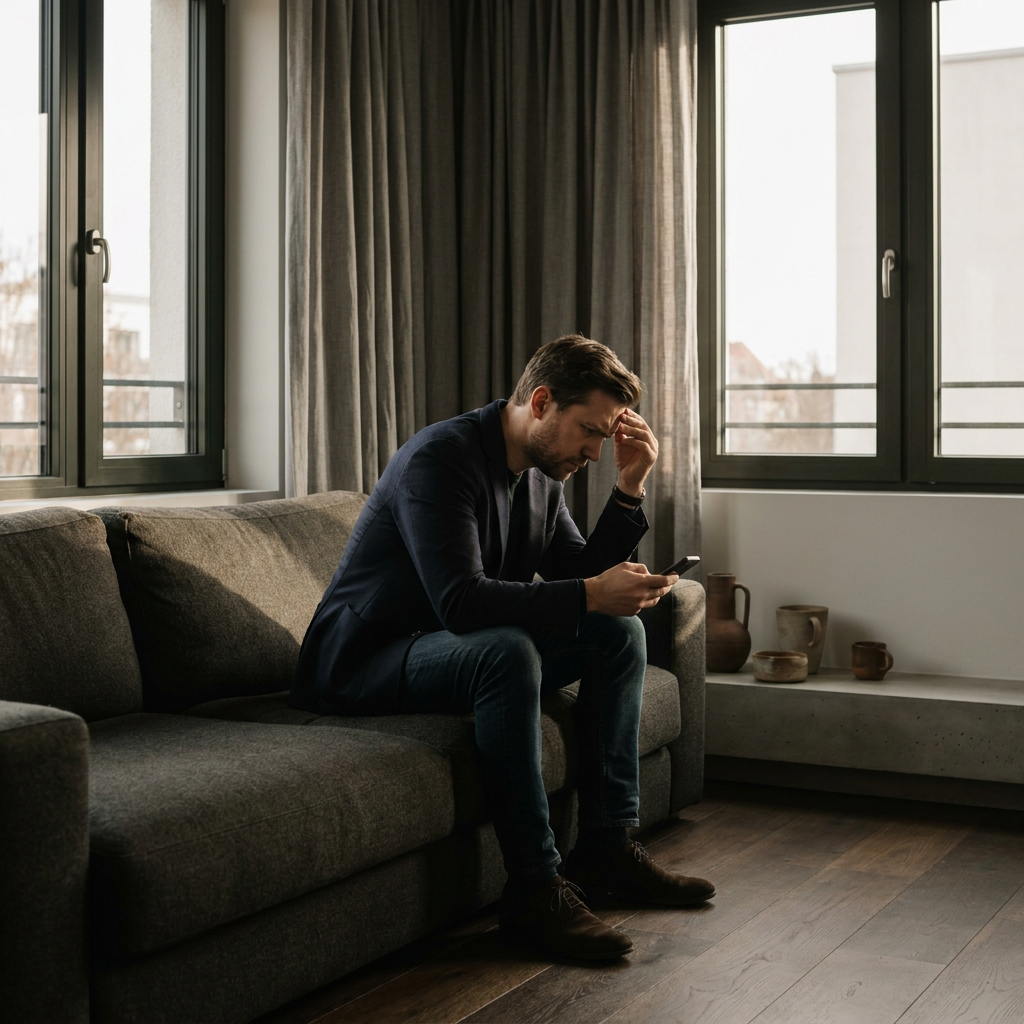
Relationship anxiety in men

Not every man with relationship anxiety looks clingy. Some look distant or controlling—obsessing over a text, then going cold to feel in control. On the surface it can pass as standards or “being careful.” Underneath, it’s often fear: rejection, losing yourself, not being enough, or being hurt again. The fix isn’t acting unaffected; performance doesn’t create peace. Honest awareness does.
Table of contents
- 1What it often looks like in real life
- 1.1Common signs of relationship anxiety in men
- 1.2Why it can look like distance, irritability, or control
- 2Where the pattern usually comes from
- 2.1Past relationships leave a blueprint
- 2.2Childhood attachment and fear of abandonment
- 2.2.1Anxious and avoidant patterns in men
- 2.3Stress, shame, and the pressure to look unaffected
- 3How relationship anxiety damages connection
- 4What actually helps
- 4.1Stop performing calm and name what is true
- 4.2Regulate your body before you react
- 4.3Separate facts from the story your fear is telling
- 4.4Communicate directly instead of testing your partner
- 4.5Get the right kind of support
- 5If you're dating a man with relationship anxiety
- 5.1How to help without becoming his emotional crutch
- 5.2If your boyfriend makes you feel anxious
- 6If you keep repeating the same relationship pattern
- Show more...
Key takeaways
- Relationship anxiety can look like distance, irritability, or control—not just clinginess.
- Roots often include past hurt, attachment wounds, and pressure to appear unaffected.
- Regulate your body before reacting; separate facts from fear’s story.
- Speak plainly instead of testing; clarity builds trust faster than drama.
- Get support when patterns repeat or overwhelm daily life; partners need empathy and boundaries.
What it often looks like in real life
Relationship anxiety is not a formal diagnosis on its own, but it is a very real pattern. It shows up as persistent stress, doubt, or hypervigilance inside dating and relationships. You may overread your partner’s tone, assume distance means rejection, crave reassurance, or shut down before anyone gets too close. Men often experience the same anxiety as anyone else, but they may express it in more hidden ways because many have been taught to suppress need, softness, and emotional uncertainty.
Common signs of relationship anxiety in men
Common signs include overthinking after dates, checking your phone compulsively, reading too much into delayed replies, needing constant reassurance, jealousy, testing your partner, self-silencing to avoid conflict, and feeling unusually tense when things start getting serious. Some men become highly attached very quickly. Others stay half in and half out, not because they do not care, but because caring feels dangerous. Physical signs can show up too: a tight chest, racing thoughts, poor sleep, restlessness, or a stomach-drop feeling when something feels “off.”
Why it can look like distance, irritability, or control
Male anxiety is often misunderstood because it does not always come out as visible fear. It may come out as irritability, criticism, emotional withdrawal, overworking, substance use, or a need to control the pace of the relationship. A man may say he needs space when what he really means is, “I feel exposed and I do not know how to handle it.” He may act unimpressed or detached when he is actually terrified of being rejected. That does not make the behavior healthy. It simply means anxiety in men often wears a mask.
Where the pattern usually comes from
Past relationships leave a blueprint
If you were betrayed, strung along, cheated on, emotionally manipulated, or repeatedly made to feel not enough, your nervous system remembers. The old relationship may be over, but your body still expects the same pain. That is why men with relationship anxiety often react to present-day partners through old emotional residue. You are not just responding to what is happening now. You are responding to what happened before and what you fear will happen again. Your history explains the pattern, but it does not get to lead your future forever.
Childhood attachment and fear of abandonment
For many men, the roots go further back. Early experiences with caregivers shape what love feels like. If love was inconsistent, critical, rejecting, or emotionally unavailable, closeness can feel unstable in adult relationships. You may crave intimacy and mistrust it at the same time. You may feel deep fear when someone pulls away, or deep discomfort when someone comes too close. Low self-worth, fear of abandonment, and a habit of scanning for rejection often start long before dating ever begins. Adult relationships simply expose what was already there. These patterns often reflect anxious attachment in men.
Anxious and avoidant patterns in men
Some men lean anxious. They pursue, overthink, and seek reassurance. Some lean avoidant. They detach, minimize feelings, and protect themselves through distance. Many men are actually a mix of both. They want closeness, then panic when they get it. They chase, then disappear. They open up, then regret it and pull back. If you recognise this push–pull, learning about anxious vs avoidant attachment can help it make more sense.
Understand True Masculinity
Stress, shame, and the pressure to look unaffected
Men are often rewarded for control, competence, and emotional restraint. That conditioning can make relationship anxiety worse. If you believe needing reassurance makes you weak, you will hide it until it leaks out sideways through passive aggression, shutdown, or control. If you believe you should always be calm, certain, and untouched, you will perform confidence instead of building it. Real confidence is not emotional numbness. It is the ability to feel uncertainty without collapsing into it or acting it out on someone else.
How relationship anxiety damages connection
Relationship anxiety creates bad dynamics even between two good people. If you constantly need proof, your partner starts feeling monitored. If you hide your needs, resentment builds. If you test your partner instead of speaking plainly, trust erodes. If you pull away every time intimacy deepens, the other person feels punished for getting close. Over time, both people get trapped. One becomes more anxious, the other more careful or more distant. This is also where partner accommodation can start: the calmer partner adjusts more and more to manage the anxious partner’s reactions. That may reduce tension short term, but it keeps the pattern alive long term.
What actually helps
Stop performing calm and name what is true
The first shift is brutally simple: tell the truth to yourself. Are you genuinely sensing a problem, or are you triggered? Are you upset about her behavior, or about what her behavior means to you? Most men do not need more strategy. They need more honesty. When you can say, “I feel activated, insecure, or afraid right now,” you stop turning internal chaos into external drama. That is not weakness. That is emotional leadership.
Regulate your body before you react
An anxious mind makes terrible relationship decisions. Before you send the long text, pick the fight, disappear, or demand reassurance, regulate your body first. Slow your breathing. Unclench your jaw. Feel your feet on the floor. Give yourself a few minutes before acting. A simple reset is box breathing: inhale for four counts, hold for four, exhale for four, hold for four, and repeat for a few rounds. It sounds basic because it is basic, and it works because anxiety is not only a thought problem. It is also a body problem.
Separate facts from the story your fear is telling
This is where many men get caught. A slow reply becomes “she is losing interest.” A need for space becomes “I am about to be abandoned.” One tense evening becomes “this will never work.” Ask yourself what you actually know, what you are assuming, and what old memory your body may be replaying. Anxiety loves certainty, even negative certainty. Maturity means refusing to treat every fear as truth.
Communicate directly instead of testing your partner
Healthy communication is less dramatic and more effective. Instead of fishing for validation, accusing, going silent, or acting cold, say what is real. You can say, “I noticed I got activated when you pulled back yesterday, and I want to talk about it without making it your job to fix me.” That kind of clarity builds trust. It also reveals something important: whether the relationship can hold honest conversation. If it cannot, that matters too.
Get the right kind of support
Some men can shift this pattern through self-awareness, better communication, and consistent inner work. Others need outside help, especially when anxiety is intense, tied to trauma, or disrupting daily life. Therapy can help with deeper wounds, attachment injuries, and persistent anxiety symptoms. Relationship Anxiety Coaching for Men can help you uncover blind spots, stop role-playing, and build grounded confidence and relational clarity. Different tools serve different needs. The point is to stop trying to out-think a pattern that clearly has a deeper root.
If you're dating a man with relationship anxiety
How to help without becoming his emotional crutch
If your partner has relationship anxiety, empathy helps, but endless reassurance does not fix the problem. Be clear, calm, and consistent. Encourage honest conversation. Do not reward mind-reading games, emotional punishment, or controlling behavior. Support does not mean shrinking your life so he can feel safe. A healthier dynamic is one where he takes responsibility for his triggers while you stay kind, direct, and committed to setting boundaries with confidence. You can care deeply without becoming his regulator.
If your boyfriend makes you feel anxious
Sometimes what you call relationship anxiety is not only your inner fear. Sometimes the relationship itself is unstable, inconsistent, or emotionally unsafe. If your boyfriend disappears, lies, keeps you guessing, criticizes you, or punishes vulnerability, your anxiety may be information. Do not pathologize your intuition just to keep a connection alive. The real question is not only, “Why am I anxious?” It is also, “What is this relationship actually teaching my body to expect?”
If you keep repeating the same relationship pattern
You do not need another mask. You need a deeper level of honesty. If you are successful on the outside but chaotic in intimacy, that does not mean you are broken. It means there is a pattern asking to be seen. SoulfulMagnet works with men who are ready to stop performing, face what is driving their reactions, and build real confidence, emotional clarity, and stronger connection. That is not about becoming softer or more pleasing. It is about becoming more real, more grounded, and far less ruled by fear.
Frequently asked questions
What are the symptoms of relationship anxiety in men?
Symptoms can include overthinking, fear of abandonment, jealousy, compulsive phone checking, reassurance-seeking, emotional shutdown, irritability, controlling behavior, and difficulty relaxing into closeness. Some men look needy. Others look distant. Both can be driven by the same fear of rejection or loss.
How do you deal with new relationship anxiety?
Move slower than your fear wants you to move. Do not fantasize a future or predict disaster after every interaction. Stay rooted in facts, keep your routine, regulate your body when triggered, and communicate directly instead of performing coolness or panic. New relationship anxiety settles faster when you stay present rather than trying to force certainty.
Can a man be both anxious and avoidant?
Yes. This is common. A man can crave connection, pursue hard, then pull away when intimacy becomes real. He may want closeness but feel trapped by it, or fear losing the relationship and losing himself at the same time. That push-pull pattern often points to mixed attachment wounds rather than simple lack of interest.
Is relationship anxiety a sign the relationship is wrong?
Not always. Sometimes anxiety is an old wound getting activated in a good relationship. Sometimes it is a real response to inconsistency, poor communication, or emotional unsafety. The work is to separate old fear from present reality. That requires self-honesty, emotional regulation, and a willingness to look at the dynamic without denial.
When should a man seek professional help?
If the anxiety keeps repeating across relationships, causes panic, obsession, sleep problems, or controlling behavior, or is tied to trauma, it is wise to get support. If daily functioning is affected, a licensed mental health professional is the right place to start. Coaching can also be valuable for men who want to break patterns, build emotional clarity, and relate from grounded strength rather than fear.
Related articles
Nice Guy Syndrome Signs
Nice Guy Syndrome often looks…
Nice Guy Syndrome: Signs, Causes, and How to Break the Pattern
Nice guy syndrome is an approv…

Men’s fear of commitment
Not every man who moves slowly…